
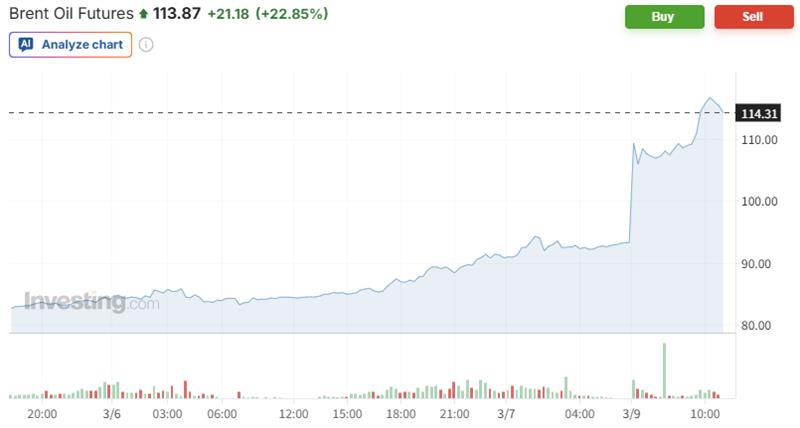
Volatility Unleashed: Brent crude surged to $118-120 before plunging below $105 within hours as G7 announced potential 400M barrel reserve release, demonstrating extreme market fragility amid Hormuz disruption fears.
🔍 Macro Analysis | 🔗 Source: TradingView, Financial Times
Risk Disclaimer: This analysis examines the G7's proposed 400 million barrel strategic petroleum reserve release and its implications for oil markets, inflation expectations, and crypto correlations as of March 9, 2026. Commodity investments carry substantial volatility risk. Oil price predictions are inherently uncertain. Geopolitical developments can render analysis obsolete within hours. This content does not constitute financial advice. Always conduct independent research and consult qualified advisors before trading energy derivatives or inflation-hedge assets.
📊 Hormuz Crisis Market Snapshot
Verified data from TradingView, Financial Times, IEA, and on-chain analytics.
The 21-Mile Chokepoint Holding Global Energy Hostage
On March 9, 2026, the Financial Times revealed that G7 nations are coordinating the largest strategic petroleum reserve release in history—up to 400 million barrels—through the International Energy Agency. This unprecedented intervention comes after Brent crude surged to near $120 per barrel, driven by escalating threats to the Strait of Hormuz, the world's most critical energy artery.
The Hormuz crisis exposes a structural vulnerability: 20% of global oil supply transits a waterway just 21 miles wide at its narrowest point, creating a single point of failure that no strategic reserve can permanently offset.
The Strait of Hormuz represents the ultimate geopolitical leverage point. According to EIA data, approximately one-fifth of global petroleum liquids consumption passes through this channel. Japan, which holds the world's third-largest petroleum reserves, faces existential exposure: over 90% of its crude imports route through the strait. When Iran threatens closure, the entire Asian industrial complex faces potential paralysis.
The immediate market reaction was violent. Oil prices plummeted from $118 highs to near $100 within two hours of the G7 announcement—a 17% intraday swing that liquidated leveraged positions across derivatives markets. Spot On Chain noted the "incredibly volatile period" saw prices correct $18 in mere hours, raising questions about market structure stability when algorithmic trading amplifies headline-driven moves.
Strategic Petroleum Arithmetic: Why 400 Million Barrels May Not Suffice
The proposed 400 million barrel release sounds substantial—equivalent to roughly four days of global oil consumption—but HFI Research's analysis reveals a troubling mismatch between supply and demand shocks. According to their estimates, tanker flow disruptions through late March could drain approximately 450 million barrels from global inventories—exceeding the entire proposed G7 drawdown.
The IEA's coordinated emergency response system, established after the 1974 oil crisis, currently holds approximately 1.2 billion barrels across member states. A 400 million barrel release would deplete one-third of this safety buffer in a single action. Historical precedent suggests caution: reserves were deployed during the 1990 Gulf War, 2005 Hurricane Katrina, 2011 Libyan civil war, and 2022 Russia-Ukraine conflict—but never at this scale relative to available stockpiles.
⚙️ The Reserve Release Paradox
Immediate Effect: 400M barrels flood markets, crashing prices and punishing speculative longs (as seen March 9 with $3.5M CBB0FE liquidation).
Medium-Term Constraint: Released barrels must eventually be replaced, creating future demand overhang that supports prices once immediate crisis passes.
Structural Vulnerability: If Hormuz remains disrupted beyond 30-45 days, reserve exhaustion meets continued supply deficit, forcing demand destruction through recession.
Geopolitical Signal: Maximum drawdown reveals policymakers' desperation, potentially emboldening Iran by demonstrating Western strategic limits.
Compounding the supply picture, Iraq and Kuwait have begun shutting in production, with the UAE expected to follow. These precautionary measures remove additional barrels from immediate availability even as reserves release. The net effect may be neutral or even bullish for prices if field restarts prove slower than anticipated.
When Leverage Meets Volatility: The CBB0FE Catastrophe
The March 9 price action extracted real blood from leveraged traders. On-chain analytics firm Arkham identified a wallet linked to known meme coin trader CBB0FE as down $3.5 million on a $12 million crude oil short position—opened as prices surged more than 50% from the previous week. The position, likely initiated around $80-85 Brent, faced immediate margin pressure as prices touched $120.
The liquidation timing reveals market microstructure fragility. CBB0FE's short represented contrarian positioning against the Hormuz panic—fundamentally rational given historical precedent for strait closures being threatened rather than executed. Yet algorithmic stop-losses and exchange liquidation engines transformed a manageable drawdown into catastrophic loss when volatility spiked.
Conversely, market observer legen.eth identified an account that opened a 5x leveraged short on crude oil approximately two hours before the G7 reserve reports emerged. This trader captured over $1 million in profits as prices collapsed below $105. The timing—suspiciously precise—raises questions about information asymmetry: was this insider knowledge of pending G7 coordination, or extraordinary risk tolerance combined with luck?
⚠️ The Information Edge Paradox
Scenario A - Insider Advantage: The profitable short suggests G7 deliberations leaked to sophisticated traders before public announcement, undermining market integrity.
Scenario B - Technical Excellence: The trader identified overbought conditions and resistance levels, executing contrarian position with precise timing based on pure market analysis.
Market Structure Implication: Either explanation reveals dangerous asymmetry—whether through information leakage or algorithmic superiority, retail traders face systematic disadvantage in volatility spikes.
Pompliano's Gambit: Why the Fed Should Ignore Oil-Driven Inflation
Beyond immediate trading carnage, the oil spike has ignited monetary policy debate. Anthony Pompliano argued forcefully that the Federal Reserve should "aggressively cut rates in the first half of this year" despite oil-driven inflation fears. His thesis rests on structural deflation: the US economy operates in a fundamentally disinflationary environment where single-commodity shocks represent noise rather than signal.
"If oil continues going higher, you will hear lots of people say the Fed should avoid cutting rates out of fear of potential inflation," Pompliano wrote. "This is the same mistake these folks made during tariffs." The reference targets 2018-2019 when the Fed paused rate hikes due to trade war uncertainty, potentially over-tightening into slowing growth.
The counterargument is equally compelling. The Kobeissi Letter's modeling suggests sustained $120 oil would reduce US GDP growth by 0.5%—equivalent to $160 billion in lost economic output. Energy costs permeate supply chains: transportation, manufacturing, agriculture, and heating all face price pressure that translates to core inflation. The 1970s stagflation precedent—where oil shocks drove wage-price spirals—haunts policymakers who remember Fed credibility being rebuilt through Volcker's painful disinflation.
President Trump offered characteristically optimistic framing, telling reporters oil prices "will drop rapidly" when the "Iran nuclear threat is over"—calling any economic disruption "a very small price to pay." This political positioning assumes successful military or diplomatic resolution, a high-confidence forecast given regional complexity.
Three Futures: Relief, Stagflation, or Strategic Exhaustion
Diplomatic Resolution Scenario
Iran de-escalates Hormuz threats following behind-the-scenes negotiations or limited military demonstration. Oil prices retreat to $85-90 range within weeks. The 400 million barrel release is scaled back or canceled entirely. G7 reserves remain intact for future crises. Fed rate cuts proceed as planned, with oil volatility dismissed as temporary shock. Crypto markets rally on restored risk appetite.
Protracted Disruption Scenario
Hormuz remains partially blocked through Q2 2026, with Iran executing intermittent harassment tactics. The full 400 million barrel release occurs, followed by additional draws from IEA reserves. Prices remain elevated at $110-115 despite interventions, forcing demand destruction through recession. Macro meltdown cascades through risk assets as stagflation takes hold. Bitcoin faces correlation breakdown—initially sold as risk asset, then potentially bid as inflation hedge if policy response turns dovish.
Managed Decline Scenario
G7 releases 200-250 million barrels—half the proposed maximum—sufficient to cool prices without exhausting reserves. Prices stabilize at $100-105, painful but not catastrophic. Iraq and Kuwait production restarts offset continued Hormuz risk premium. The Fed pauses cuts but doesn't hike, maintaining optionality. Markets enter liquidity vacuum as participants await clarity, with crypto trading in compressed ranges.
The Crypto Correlation Question: When Oil Met Digital Scarcity
The Hormuz crisis arrives at a critical juncture for crypto market narratives. Bitcoin's "digital gold" thesis faces live testing: if oil-driven inflation accelerates while BTC fails to rally, the inflation-hedge positioning collapses. Conversely, if BTC decouples from risk assets and appreciates amid commodity chaos, institutional adoption accelerates.
Historical precedent offers limited guidance. The 2022 Russia-Ukraine conflict—similarly energy-driven—saw initial crypto rally followed by correlation with tech stocks during Fed tightening. The difference in 2026 is potential Fed dovishness: where 2022 featured rate hikes, current conditions suggest cuts regardless of oil prices. This monetary policy divergence could enable crypto outperformance even if energy costs spike.
Stablecoin flows provide real-time sentiment indicators. Tether's $187 billion supply represents dry powder for crypto purchases; if oil volatility drives flight-to-safety into USDT rather than USD banking, crypto markets benefit from liquidity concentration. The CBB0FE liquidation—meme coin trader destroyed in oil markets—symbolizes capital rotation potential: speculators exiting traditional commodity leverage for digital asset exposure.

About the Author: Alexandra Vance
Alexandra Vance is a market analyst specializing in macro commodity cycles, geopolitical risk assessment, and the intersection of traditional energy markets with cryptocurrency correlations.
Risk Disclaimer: This analysis is for informational purposes only and does not constitute financial advice. Oil markets are experiencing extreme volatility with 17% intraday swings. The G7's proposed 400 million barrel reserve release may or may not materialize. Geopolitical developments can render analysis obsolete within hours. Energy price predictions are inherently uncertain. Crypto correlations with commodities shift rapidly and unpredictably. Always conduct independent research and consult qualified advisors before trading oil derivatives, energy equities, or cryptocurrency positions.
Update Your Sources
For ongoing monitoring of oil markets and Hormuz developments:
- Financial Times G7 Report – Original 400M barrel reserve release coverage
- IEA Emergency Response – Strategic petroleum reserve data and coordination protocols
- EIA Hormuz Analysis – Strait of Hormuz flow statistics and energy security data
- HFI Research Oil Outlook – Tanker disruption estimates and inventory analysis
- TradingView Oil Charts – Real-time Brent and WTI price data
Note: Oil price data reflects March 9, 2026 intraday volatility. G7 reserve release remains under deliberation and may not materialize as proposed. Hormuz shipping status changes rapidly; verify current conditions through maritime security advisories. IEA reserve figures are estimates based on member state reporting.
Frequently Asked Questions
On March 9, 2026, G7 nations proposed coordinating the largest-ever strategic petroleum reserve release—up to 400 million barrels—through the International Energy Agency (IEA). This would represent one-third of total IEA emergency reserves (1.2 billion barrels) and aims to counter oil prices surging to $120/barrel amid Strait of Hormuz disruption threats. Three G7 members including the US have signaled support, though Japan initially denied a final decision had been made.
The Strait of Hormuz is the world's most important oil chokepoint, with approximately 20% of global petroleum liquids consumption transiting through its 21-mile-wide narrowest point. Over 90% of Japan's crude imports route through the strait. Iran's threats to blockade this waterway create immediate supply risk that drove Brent crude to $120 on March 9, 2026. Any prolonged closure would force massive demand destruction through recession, as alternative supply routes cannot compensate for 20% of global consumption.
Oil prices experienced extreme volatility on March 9, 2026. Brent crude surged to $118-120 amid Hormuz panic before plummeting below $105 within two hours of the G7 announcement—a 17% intraday swing. Prices stabilized around $103-104 by session close. This volatility liquidated leveraged positions including a $12M crude short by trader CBB0FE that lost $3.5M, while another trader profited over $1M on a 5x leveraged short opened two hours before the news.
Anthony Pompliano argues the Federal Reserve should "aggressively cut rates" despite oil-driven inflation fears, stating the US operates in a structurally deflationary environment where single-commodity shocks represent noise rather than signal. He warns against repeating the 2018-2019 "tariff mistake" when the Fed paused hikes due to trade war uncertainty. Pompliano believes oil price spikes are temporary supply shocks that shouldn't override broader disinflationary trends requiring monetary easing.
According to HFI Research, the 400 million barrel release may be insufficient. Their estimates indicate tanker flow disruptions through late March could drain approximately 450 million barrels from global inventories—exceeding the proposed G7 release. Additionally, Iraq and Kuwait have begun shutting in production, with UAE expected to follow, removing further supply. The IEA's 1.2 billion barrel total reserves would be depleted by one-third in this single action, leaving diminished capacity for future crises if Hormuz remains disrupted beyond 30-45 days.